Platform consolidation and something else about artificial intelligence.
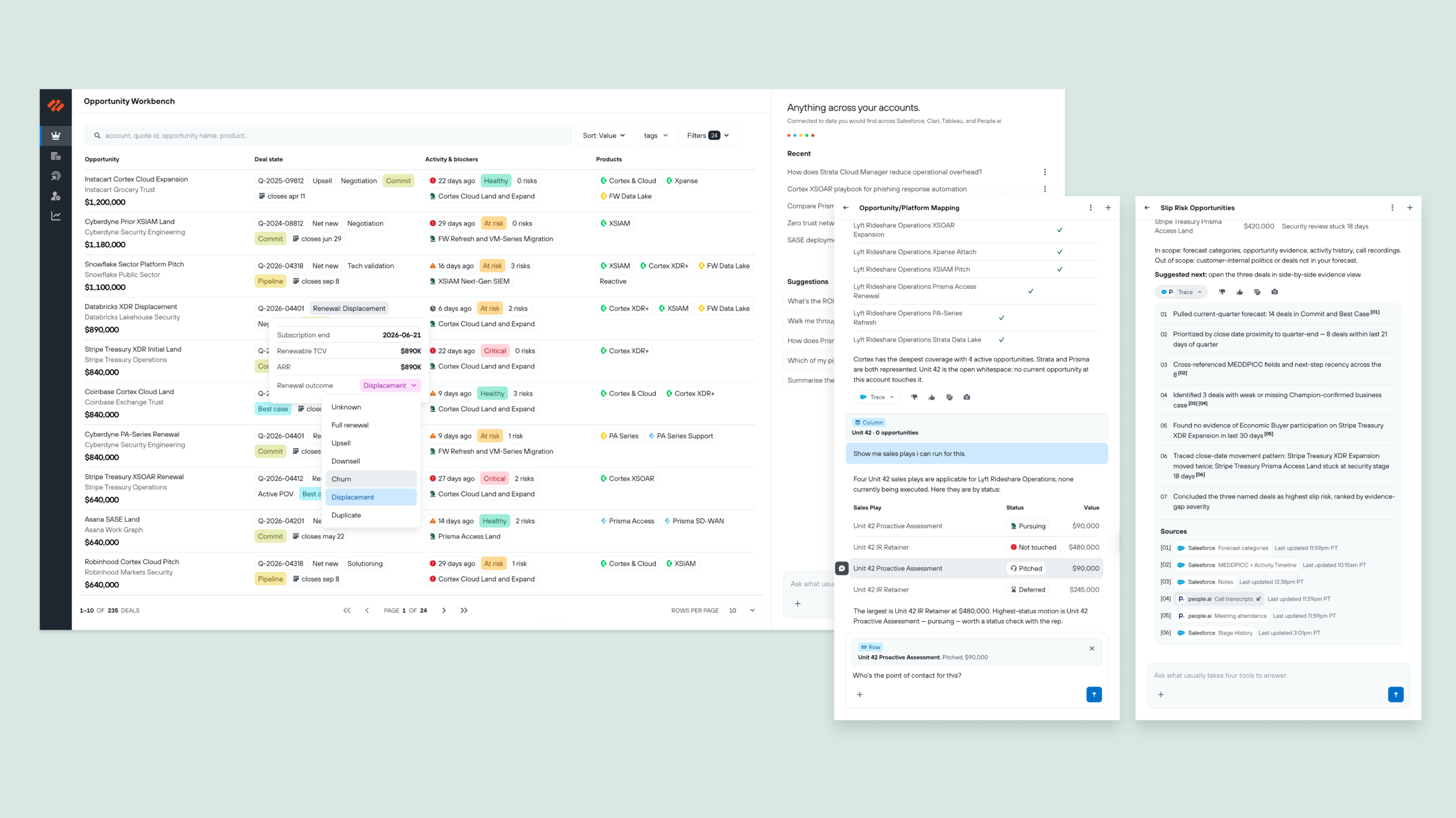
I designed a consolidated workbench for Palo Alto Networks' account executives, unifying scattered sales tooling and shaping AI responses for live opportunity work.
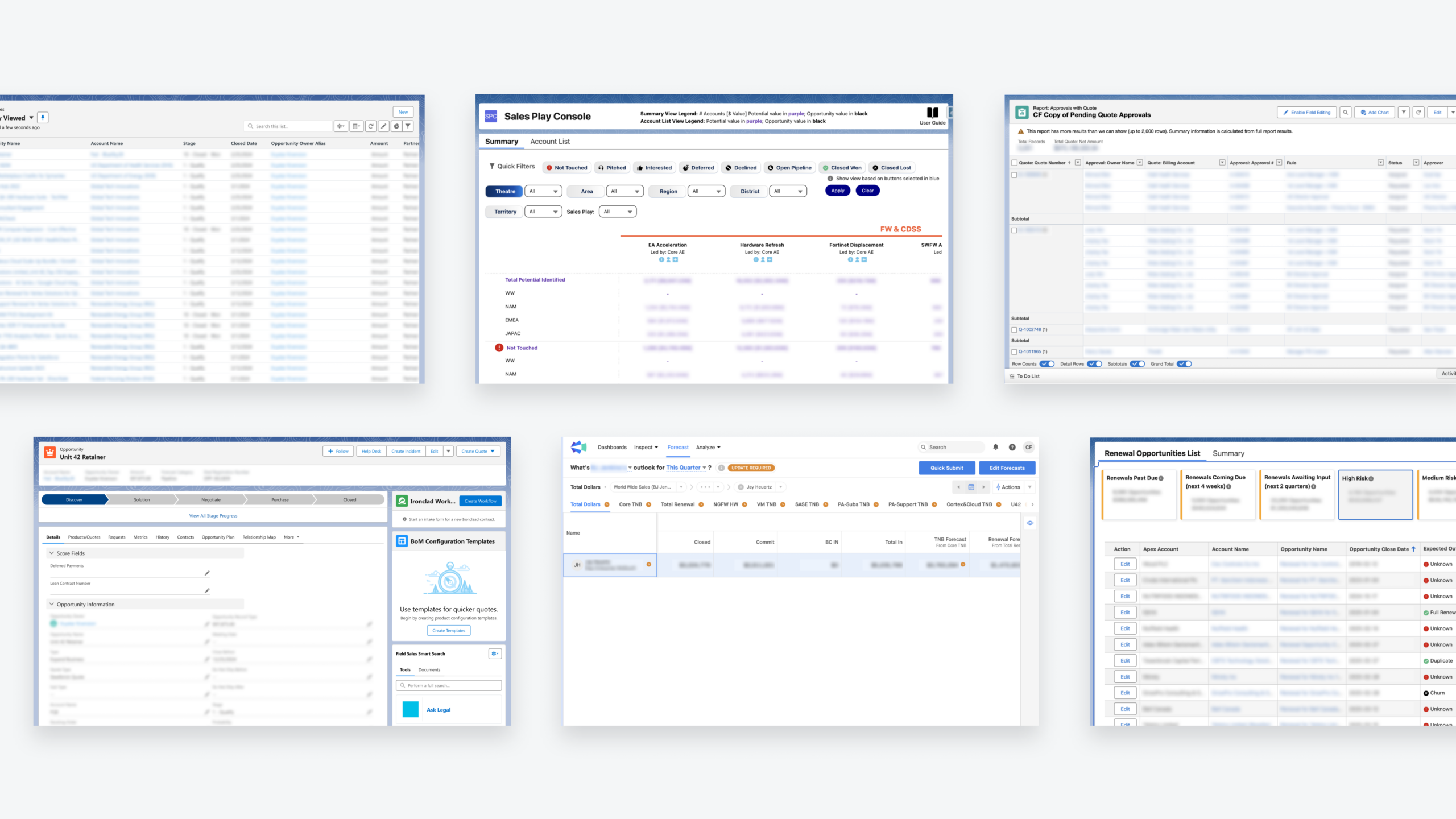
A SMALL COLLECTION OF EXISTING TOOLS, MANY OF THEM BEING SINGLE-PURPOSE TOOLS.
Problem #01:
Endless pages, each serving a single purpose.
A single opportunity record lived across multiple internal platforms, each owned by a different team. Updating it meant moving between tools, with changes that fed directly into account executives’ own performance measures. The conventional answer to multi-source data was a table with 20+ columns and horizontal scrolling, with links redirecting to the respective tools. This approach was familiar to users but slow at each user interaction.
Solution:
Rethinking the 20+ column table.
To consolidate the scattered tools, I designed a new table format in which data points are grouped thematically within each row and rendered as interactive tags. A user reads grouped tags vertically rather than scrolling twenty columns horizontally, and updates the underlying data by interacting with the tag directly, without leaving the workbench or pivoting to another tool. The pattern became the default for multi-column tables across the system.
Outcome:
Continued consolidation of a user's digital footprint, with a new design pattern standardized.
7 distinct tools experienced a permanent reduction in traffic as users came to our new platform.
The design pattern also became a blueprint for how the internal team will continue to work with large volumes of data.
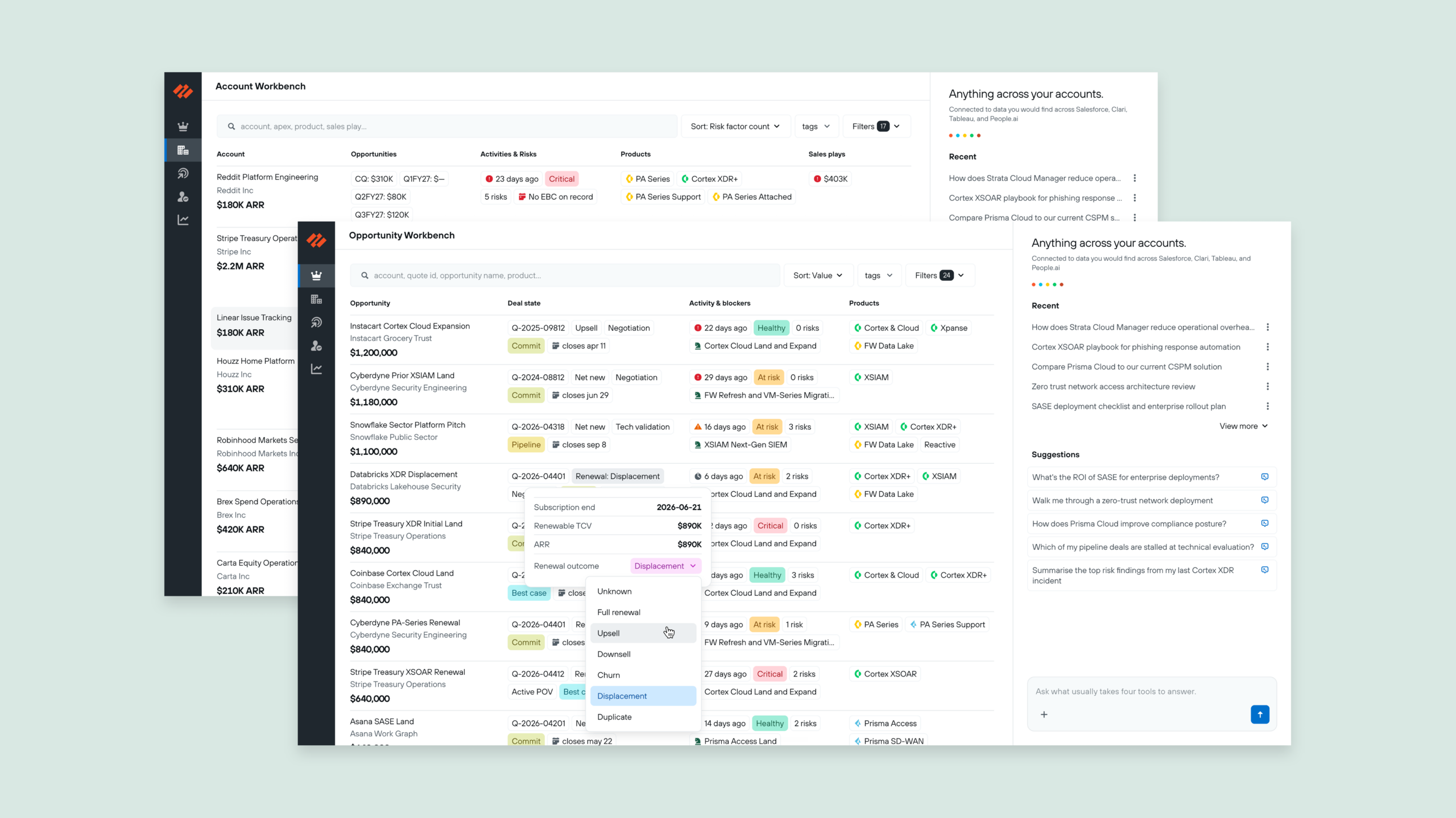
MULTI-COLUMN TABLES REDESIGNED WITH INTERACTIVE TAGS, WITH ADDITIONAL INFORMATION LAYERED THROUGH POPOVERS.
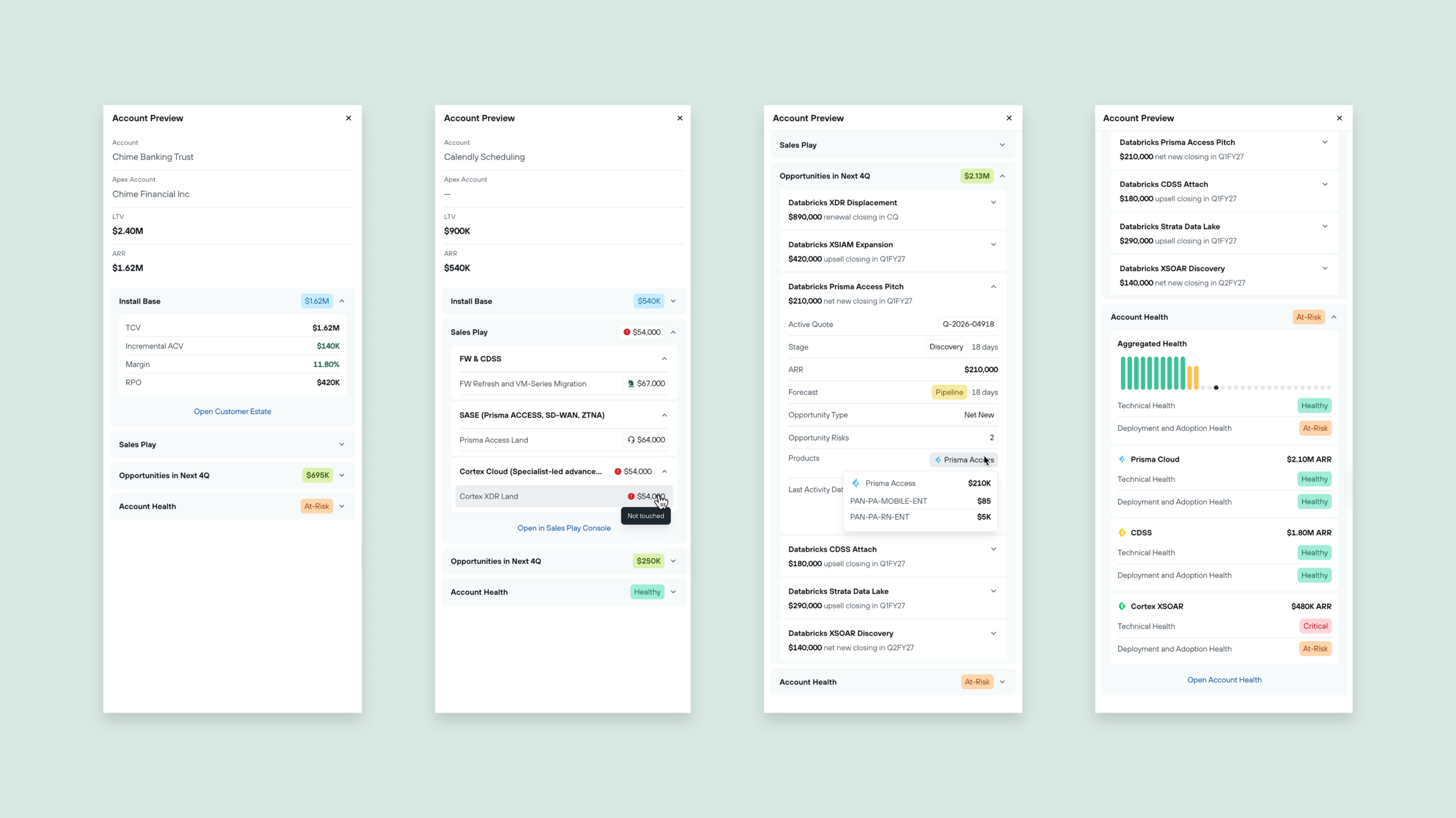
STANDARDIZED INFORMATION PANELS CONSOLIDATING INFORMATION FROM SINGLE-PURPOSE PAGES AND PLATFORMS.
Problem #02:
Selling a chatbot to spreadsheet-native workers.
This project was initiated amid the hype surrounding the introduction of AI chatbots into existing tools. The biggest challenge came with the hype: "AI can now provide insights and recommend next steps needed for any information work."
Users spent decades building fluency on structured surfaces, such as tables, dashboards, and forms, which they scan and act on directly. AI arrived as continuous prose in a chat thread, which the user read but did not interact with.
The mismatch showed up most acutely in two places.
- The tabular data they worked with every day stayed outside the AI conversation, even when it was the obvious anchor for the next question.
- When a sales lead had to verify how a number was derived, the reasoning arrived as a narrative chain that they had to read through to extract the steps.
Solution:
Moving from 'Insights' to iterative synthesis.
Solution 02.a
Internal staff members read tabular data fluently. Using the CopilotKit, I proposed designs that extended the fluency into the AI responses themselves: tables render inline in chat, and a user follows up by annotating a specific column or row to scope the next question.
Solution 02.b
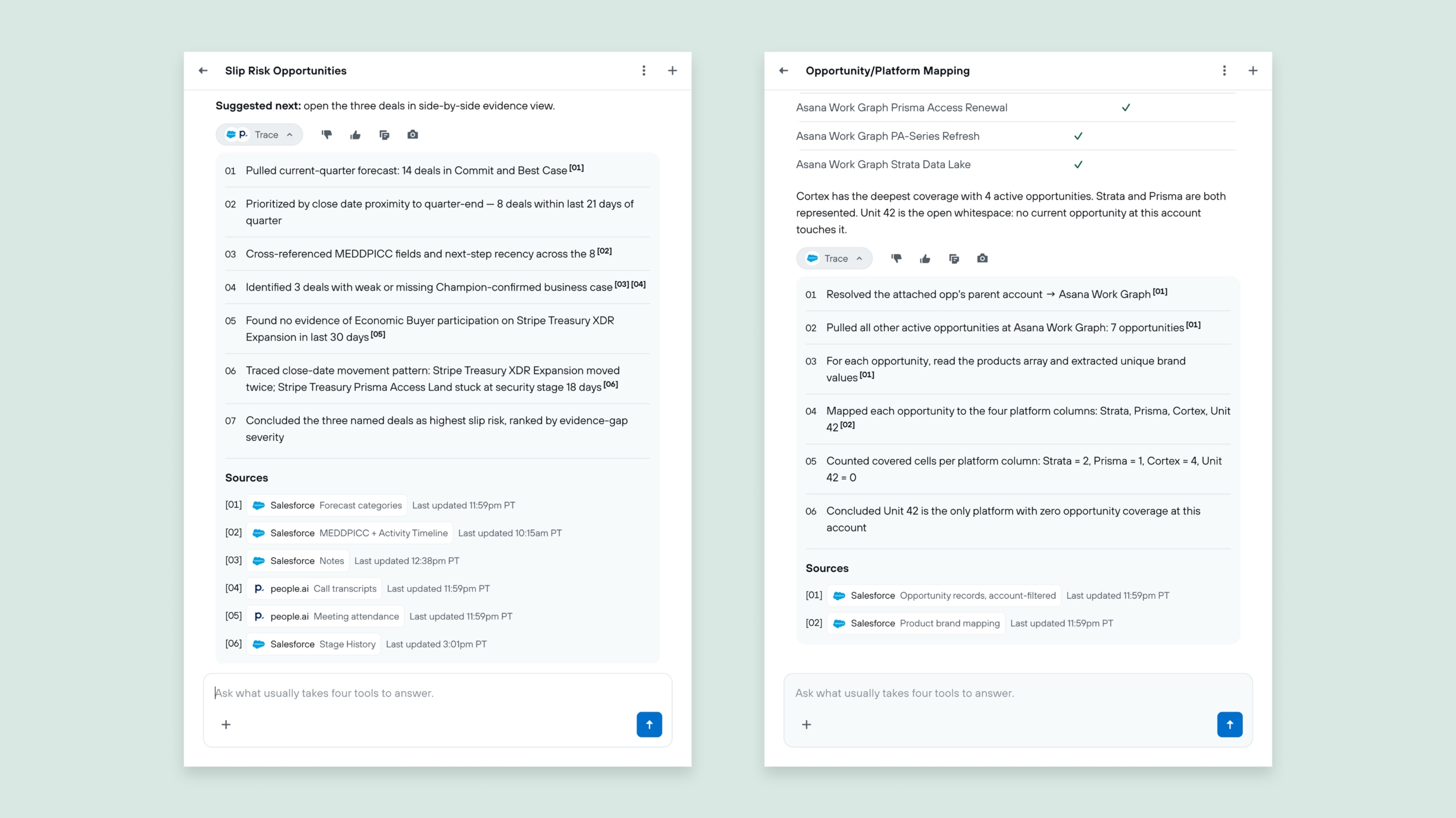
To ensure transparency and reliability in the derivation, I introduced a feature called Trace.
Rather than exposing the model’s full reasoning narrative, Trace breaks it into four to seven concrete steps. Each step lists its sources and the timestamp of their last update. A user verifying a number against live data sees both the path and the freshness of the inputs in a single view.
Outcome:
Continued consolidation of a user's digital footprint, with a new design pattern standardized.
7 distinct tools experienced a permanent reduction in traffic as users came to our new platform.
The design pattern also became a blueprint for how the internal team will continue to work with large volumes of data.
The annotation pattern was extended across the wider workbench. Any row of the interface can serve as the anchor for a follow-up, making the next response targeted rather than generic.
In practice, we found that team members would snap together a response and its trace, and drop it into a Slack thread to defend a number in a conversation with a colleague. The pattern became frequent enough that snapshotting was promoted into its own feature. We took this as a clear signal for Trace's impact on data-driven decision-making.
The annotation pattern was extended across the wider workbench. Any row of the interface can serve as the anchor for a follow-up, making the next response targeted rather than generic.
In practice, we found that team members would snap a response and its trace together, and drop it into a Slack thread to defend a number in a conversation with a colleague. The pattern became frequent enough that snapshotting was promoted into its own feature. We took this as a clear signal for Trace's impact on data-driven decision-making.
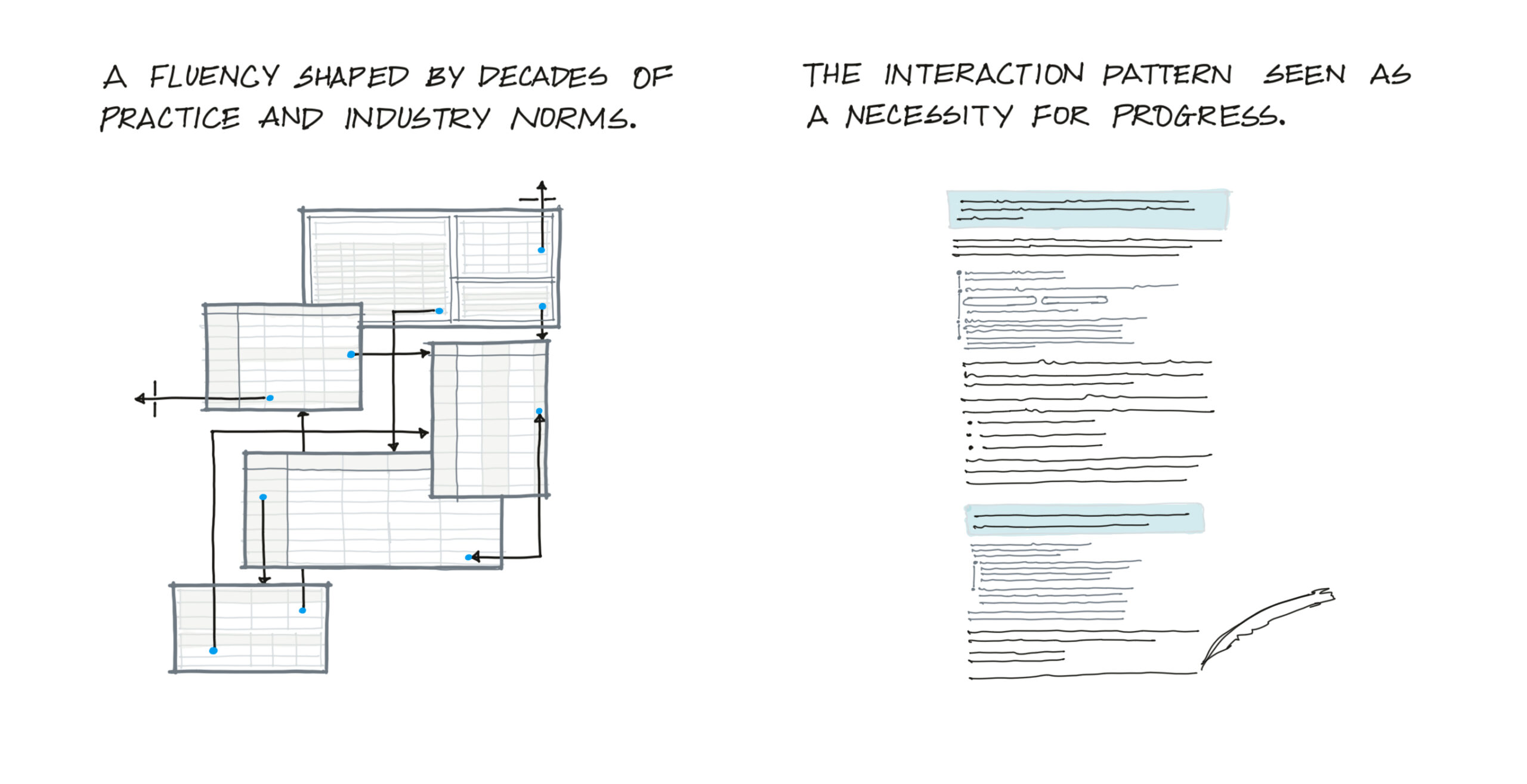
DICHOTOMY BETWEEN USER VERNACULAR AND EMERGING INTERACTION PATTERNS.
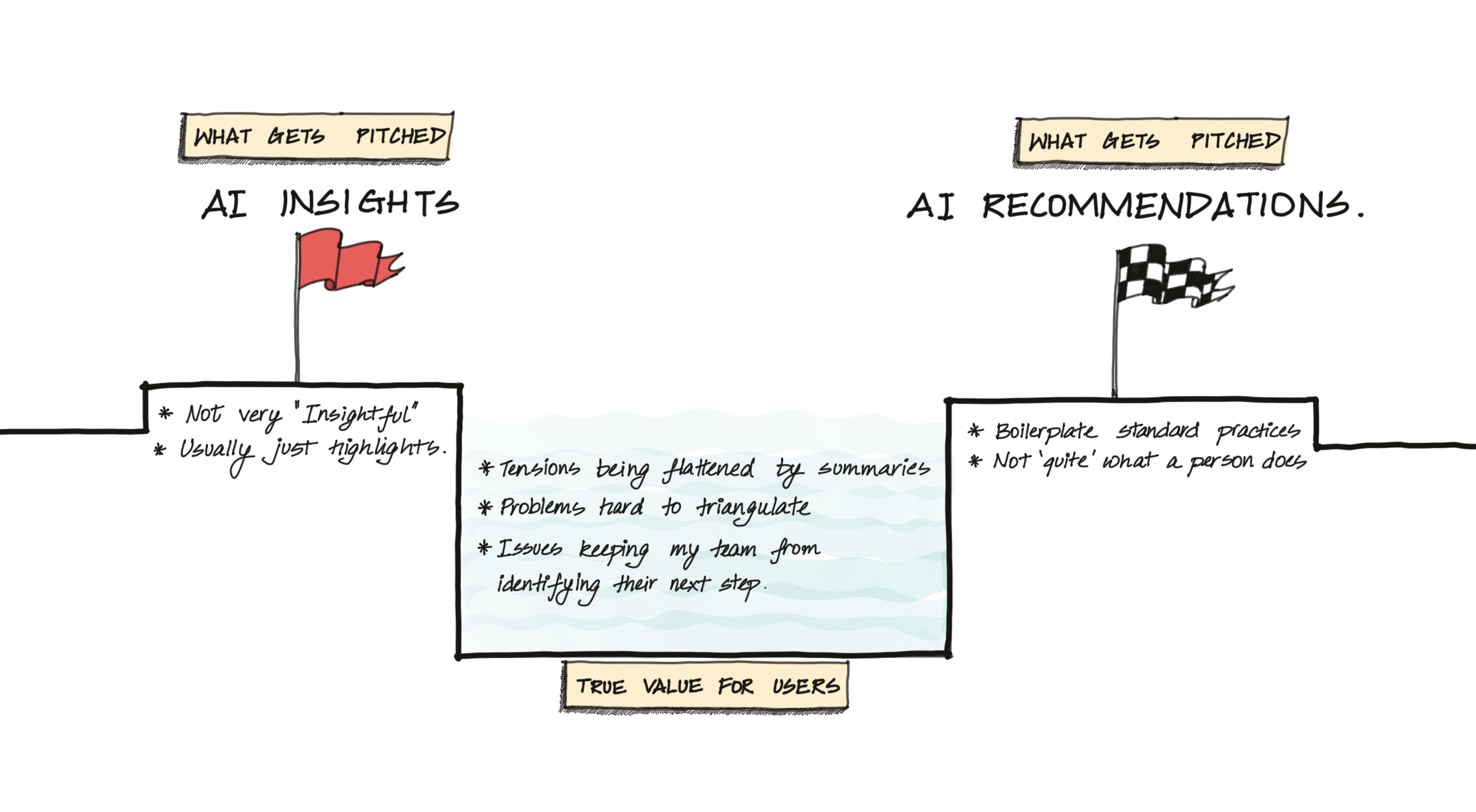
DISTINGUISHING HYPE FROM POTENTIAL.
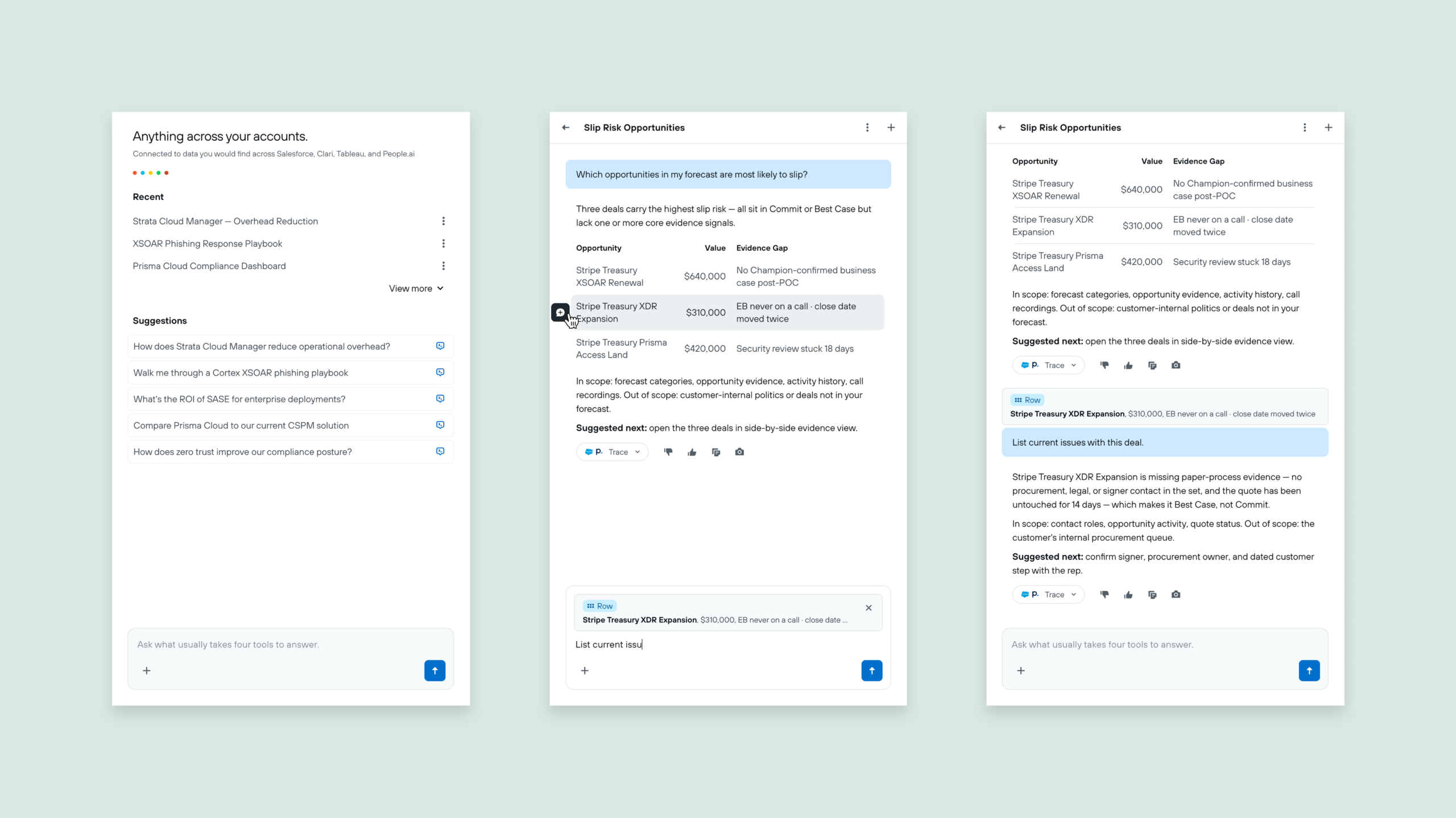
STANDARDIZED INFORMATION PANELS CONSOLIDATING INFORMATION FROM SINGLE-PURPOSE PAGES AND PLATFORMS.
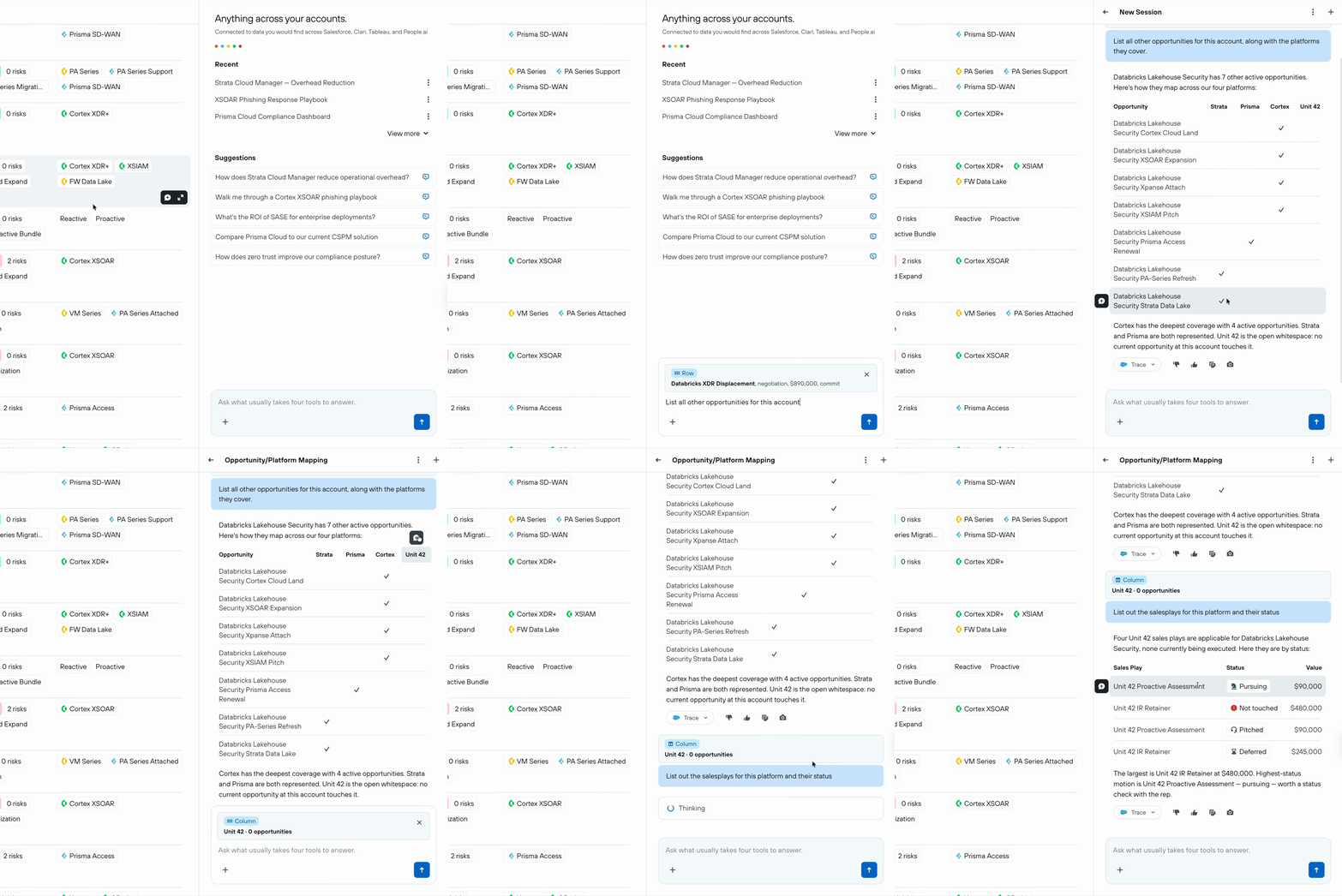
INTERACTIONS INITIATED BY ANNOTATING CONTENT ON A PAGE.
A SHORT SENTENCE ACTING AS A PLACEHOLDER FOR CAPTIONS TO AN IMAGE. WE CAN KEEP THIS SENTENCE A LITTLE LONG JUST TO SEE WHAT MULTI-LINE CAPTIONS MIGHT LOOK LIKE.
Takeaway.
1. Progress lies somewhere between dismissing hype and embracing it.
2. Generative AI can help with execution and ideation, but still lacks the skills needed for problem setting and the messiness between ideation and execution.
Selected Works